The bottleneck is no longer delivery.
It's judgment.
AI is not replacing product design. It is moving the leverage upstream. The advantage moves toward better discovery, better judgment, better systems, and enough confidence to make the next decision.
Delivery Is Catching Up. Decision-Making Is Not.
The uncomfortable truth: many teams are getting faster at producing work than deciding what work matters. AI makes it easier to produce options: more concepts, more prototypes, more tickets, more UI, more code. But more output also creates more noise.
A team that needs two months to decide what to test will lose to a team that can test, learn, and kill three directions in two weeks.
That does not mean teams should become careless. It means discovery needs a different rhythm.
Discovery Becomes About Confidence, Not Certainty.
Spending two months on a research track can make the product direction obsolete before the team has acted on it.
Discovery needs to move in smaller loops: timeboxed research, fast synthesis, lightweight prototypes, and sharper assumptions.
The approach starts with the goal. What outcome is the team trying to move toward? That outcome becomes the scope. Other opportunities are not dismissed, but parked until they support the right outcome. It can feel brutal, but that is how you protect speed.
Then create the rhythm: two or three customer interviews each week, opportunity mapping with Product and Engineering within 24 hours. Prioritised assumptions and one validation test before the week ends.
Finally, the team needs a fixed decision moment. Did the technical spike prove feasibility? Did the smoke test prove desirability? Did the prototype reduce confusion? What do we sunset, and what deserves more investment?
Discovery is not about certainty. It is about creating enough confidence to make the next decision.
Synthesis Gets Faster, But It Also Gets Easier to Flatten the Truth.
AI is useful for synthesis. I use it to work through interviews, support data, research notes, survey results, product feedback, and analytics.
At NGRAVE, that meant analysing recurring Helpcenter tickets to find the four questions driving 20% of support demand. It also meant using AI to synthesise more than 1,000 coin and chain requests, separate sustained demand from short-lived trends, and turn the backlog into a shortlist of 5 chains Product and Engineering could defend.
But synthesis is not understanding. After interviews, designers should still write their own notes. Not because AI cannot summarise, but because a transcript does not capture everything: hesitation, contradiction, gestures, emotion, and context.
Use AI to organise the material. Use it to compare notes, cluster patterns, and challenge your interpretation. Use tools like NotebookLM to bring research material together and reduce hallucinations by grounding the model in source material. But do not outsource your understanding.
Validation Gets Messy. That Is a Good Thing.
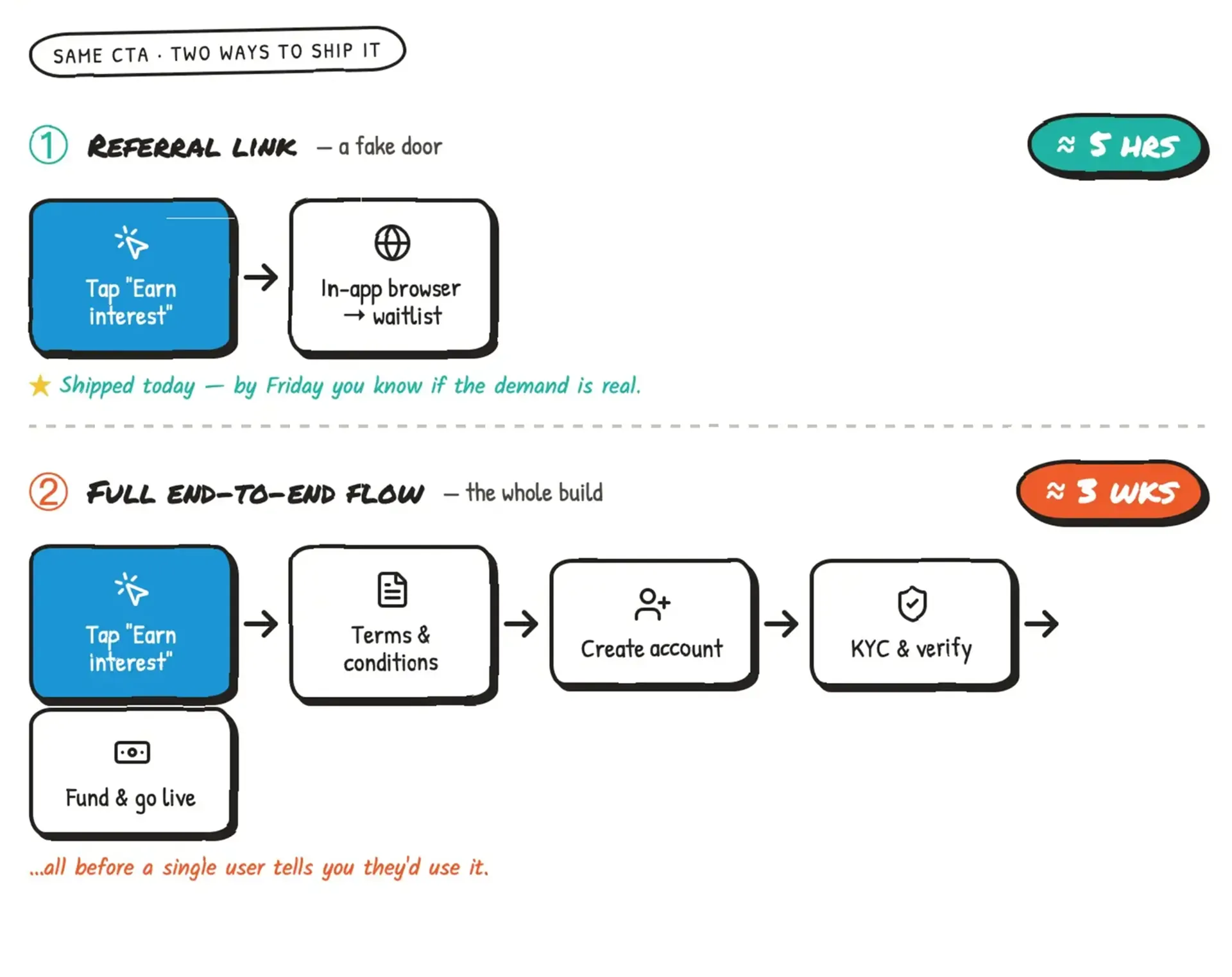
Not every prototype needs to be beautiful. Not every validation needs to be a prototype. Not every validation needs design.
As a designer, it becomes important to accept that the goal is learning, not creating. A feature entry point can lead to a lightweight "coming soon" page, just to measure intent before the team builds the real flow. At NGRAVE, referral links let us test lending and OTC demand before spending engineering time on full end-to-end flows. A manual workflow behind the scenes can prove whether the user value is real before the team automates it. Even scoping an implementation to one target audience and one task can move the decision forward.
Sometimes the fastest way to learn is to build a rough version, release it, test the flow, and see where the thing breaks or the metrics fall short.
AI lowers the cost of testing assumptions. The question becomes: what is the cheapest version of this idea that can teach us something real?
UI Design Still Matters. Maybe More Than Before.
If everyone can generate interfaces, interface judgment becomes more important, not less.
AI can produce screens, layouts, and variants. But it does not automatically understand hierarchy, trust, accessibility, context, brand, business pressure, or the emotional weight of a product moment.
A banking flow, a hardware wallet backup, a security report, and a marketing landing page do not need the same kind of interface. AI can generate interface options. It cannot decide which one earns trust.
Design Systems Need to Move Closer to Code.
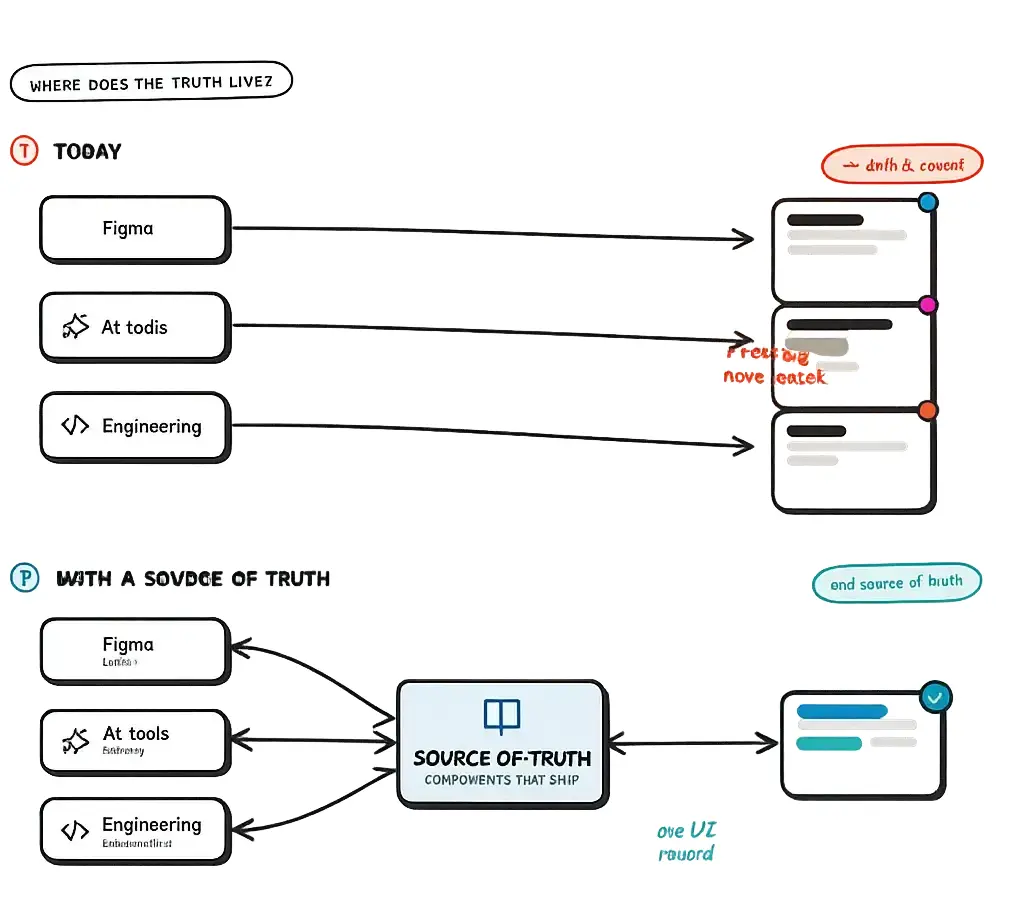
If AI speeds up interface production, design systems become more important. But they cannot only live in Figma.
AI amplifies the foundation it works from. If the product has clear tokens, coded components, states, accessibility rules, and documented patterns, AI can help teams move faster without fragmenting the experience. Without that foundation, AI does not remove design debt. It accelerates it.
That changes what a design system is for. It is no longer only a consistency project for designers. It becomes an operating layer for how teams produce interface work: designers, engineers, product managers, and AI tools all need to work from the same rules.
Teams need a stronger bridge between design and code. A useful design system should help teams answer: does this component already exist, how does it behave, what states does it support, what accessibility rules apply, and what should AI-generated UI reuse instead of inventing again?
This is where tools like Storybook become more important. Not as documentation theater, but as the middle layer between design, code, and AI-assisted delivery. Figma can define the intent. Storybook shows the truth of what actually ships. AI needs both if teams want speed without drift.
The Bottleneck Is No Longer Delivery. It's Judgment.
AI changes the speed of making. But product work is not only making. It is choosing.
Choosing what problem matters. Choosing what evidence is enough. Choosing what to test. Choosing what to ignore. Choosing when to move. Choosing when to stop.
The teams that win will not be the ones with the most output. They will be the ones that can learn faster, decide faster, and still know what good looks like.